Designing for Calm: How Thoughtful Spaces Help People with Dementia Find Their Way
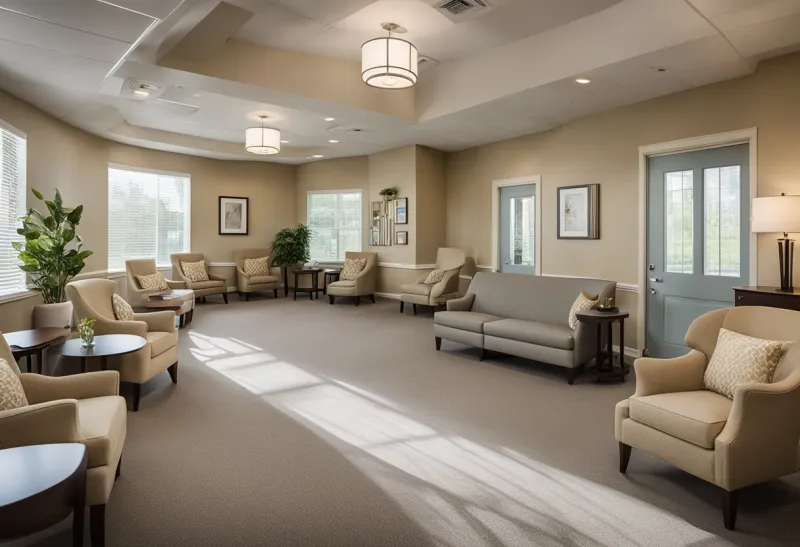
Photo: bright warm memory care facility hallway with clear signage and natural light, via koala.sh
When a guest walks into a well-designed hotel lobby, something subtle happens. The lighting is warm but sufficient. The pathways are clear and logically arranged. Signage appears exactly where the eye naturally travels. Colors anchor different zones without creating visual chaos. The guest, often arriving tired and disoriented from travel, feels—almost immediately—that they know where they are and where they are going.
This is not accidental. It is the product of decades of research into how physical environments shape human cognition, behavior, and emotion. And increasingly, the same body of knowledge is being applied to one of the most pressing challenges in dementia care: how to design spaces that help people with cognitive impairment navigate their surroundings with greater independence, less anxiety, and fewer episodes of distress.
The Environment as a Clinical Variable
Environmental gerontology—the study of how physical settings affect the aging brain—has established that the built environment is not a neutral backdrop to dementia care. It is an active participant. A poorly designed space can amplify confusion, trigger agitation, and accelerate functional decline. A well-designed space can do the opposite.
"We tend to think of dementia interventions as pharmaceutical or behavioral," says one environmental gerontologist whose work focuses on memory care facility design. "But the room itself is an intervention. The hallway is an intervention. The color of the floor is an intervention."
This perspective is gaining traction in the United States as memory care facilities face growing pressure to improve quality of life metrics while managing costs. Non-pharmacological approaches to behavioral symptoms—including wandering, agitation, and sundowning—have become a priority as clinicians seek to reduce reliance on antipsychotic medications, which carry significant risks for older adults.
Wayfinding: The Art of the Obvious
For people with dementia, spatial disorientation is among the most distressing aspects of daily life. The inability to locate a bathroom, find a dining room, or identify one's own bedroom generates anxiety that frequently escalates into agitation or wandering.
Effective wayfinding design addresses this by making navigation intuitive rather than effortful. This means eliminating ambiguity at decision points—places where a person must choose a direction—and ensuring that destinations are visible from a distance wherever possible. Long, identical corridors are among the worst offenders in traditional care facility design; they offer no visual cues to distinguish one section from another and no landmarks to anchor a person's mental map.
Successful redesigns have replaced these environments with curved or segmented hallways, distinct visual themes for different wings, and large-format signage placed at eye level for a seated or stooped individual. Some facilities have introduced "memory boxes" outside residents' rooms—small display cases containing photographs and meaningful objects that help residents identify their own door without reading a room number.
In residential home settings, similar principles apply. Removing interior doors that lead to hazardous areas, using contrasting colors to distinguish doorframes from walls, and placing clear visual cues near bathrooms and kitchens can significantly reduce disorientation for people aging in place.
Light as a Regulator
Lighting is perhaps the most underappreciated variable in dementia care environments. The aging eye requires significantly more light to process visual information than a younger eye does—and the visual system in dementia is further compromised by neurological changes that affect contrast sensitivity and depth perception.
Insufficient or poorly distributed lighting contributes directly to falls, misidentification of objects, and the phenomenon known as sundowning—the increase in confusion and agitation that many people with dementia experience in the late afternoon and early evening. Research suggests that this pattern is partly driven by disruption to the circadian rhythm, which is regulated by light exposure.
Facilities that have invested in dynamic lighting systems—those that modulate color temperature and intensity throughout the day to mimic natural light cycles—have reported reductions in sundowning episodes and improvements in sleep quality among residents. For home caregivers, simpler interventions such as maximizing natural light during daytime hours, eliminating harsh overhead fluorescents, and using nightlights with warm-spectrum bulbs in key pathways can produce meaningful improvements.
Glare is an equally important consideration. Highly polished floors and large windows without diffusion can create glare that is disorienting or even painful for individuals with dementia, contributing to reluctance to move through certain spaces.
Color Psychology and Spatial Legibility
Color in dementia care environments serves a function well beyond aesthetics. High contrast between floors and walls helps individuals with depth perception difficulties understand where surfaces begin and end—a critical factor in fall prevention. Contrasting toilet seats and grab bars make bathroom fixtures legible for people who might otherwise fail to distinguish them from surrounding surfaces.
Color can also be used to communicate zone identity. Consistent color coding across a facility—blue for common areas, green for outdoor access points, warm neutrals for private rooms—creates a visual grammar that residents can learn and rely upon even as verbal comprehension declines.
Conversely, certain color choices can create unintended problems. Dark-colored floors are sometimes perceived as holes or drop-offs by individuals with dementia, triggering fear responses and refusal to walk. Busy patterned carpets can be visually interpreted as moving objects. These are not merely aesthetic failures; they are environmental barriers with real behavioral consequences.
Real-World Renovations: What Changed and What Happened
A memory care community in the Pacific Northwest undertook a comprehensive environmental redesign several years ago, guided by principles from both environmental gerontology and hospitality design. The project included the introduction of distinct neighborhood zones with individualized color palettes, the replacement of institutional corridor lighting with layered warm-spectrum fixtures, the installation of large-print wayfinding signage at consistent heights, and the creation of a secure outdoor garden with clear visual access from interior common areas.
Staff reported a measurable decline in wandering incidents in the months following the renovation, along with a reduction in PRN (as-needed) medication use for agitation. Family members noted that their loved ones appeared more settled during visits. While the facility's leadership is careful to attribute these outcomes to multiple concurrent changes in care practice, the environmental redesign was considered a central component of the improvement.
For families caring for a loved one at home, the scale of intervention need not be dramatic. Occupational therapists who specialize in home modification can assess a residence and recommend targeted changes—often low-cost ones—that meaningfully reduce confusion and hazard. Many Area Agencies on Aging across the United States offer home modification assistance programs for qualifying families.
Designing with Dignity
Underlying all of these principles is a commitment that extends beyond safety and function. The best dementia-supportive environments are those that communicate respect—that tell the person living within them that they are still a full human being whose comfort, autonomy, and sense of self matter.
A hotel lobby works not merely because it is well-lit and clearly signed. It works because it has been designed with the guest's experience at the center. That same orientation—placing the person with dementia at the center of every design decision—is what transforms a building into a place where someone can still, in some meaningful way, find their way home.